Dartmoor moorland
The Hound of the BaskervillesDartmoor moorland is the desolate landscape surrounding Baskerville Hall and the principal setting for the danger and pursuit that shape the story. Its scattered settlements, difficult terrain, and shifting visibility make it more than a backdrop: the moor limits movement, hides people and signals, and makes familiar routes uncertain.
Setting and Geography
A large-scale map places Baskerville Hall near the center of the district, with Yew Alley running along the edge of the surrounding wood and the moor beyond it. Within five miles lie only a few scattered dwellings, including Lafter Hall, the house associated with the naturalist Stapleton, and the moorland farmhouses High Tor and Foulmire. Grimpen village, where Dr. Mortimer has his headquarters, is a small cluster of buildings; Princetown and its prison lie fourteen miles away. Between these sparse points stretches a largely empty expanse.
The approach to the moor marks a sharp change in landscape. On the journey south, fertile fields, hedged lanes, and wooded country give way to russet and olive slopes scattered with boulders and isolated stone cottages. Baskerville Hall stands in a cup-shaped hollow among storm-bent trees, with two narrow towers rising above them. The contrast makes the moor feel both remote and exposed: broad open ground is interrupted by rocks, hollows, and isolated structures that interrupt the view and complicate travel.
Routes, Hazards, and Local Knowledge
The moor’s apparent openness is misleading. A broad northern plain, broken by strange hills, looks suitable for riding, and bright green patches seem more fertile than the surrounding ground. Stapleton warns that the idea of galloping there has cost lives. He says that safe passage depends on remembering complex landmarks, implying that the terrain cannot be crossed reliably by sight or by a simple, direct route. The danger lies partly in the gap between what the ground appears to offer and what a traveler can safely know about it.
The district also carries a reputation for uncanny danger. Mortimer reports that, before the tragedy at Baskerville Hall, several witnesses described a huge, luminous, spectral creature on the moor, each account resembling the legendary hound. Their reports have spread fear through the area, and crossing the moor at night has become an act few residents are willing to undertake. The accounts establish the power of the legend over local life, not proof that the apparition is supernatural.
Concealment and Pursuit
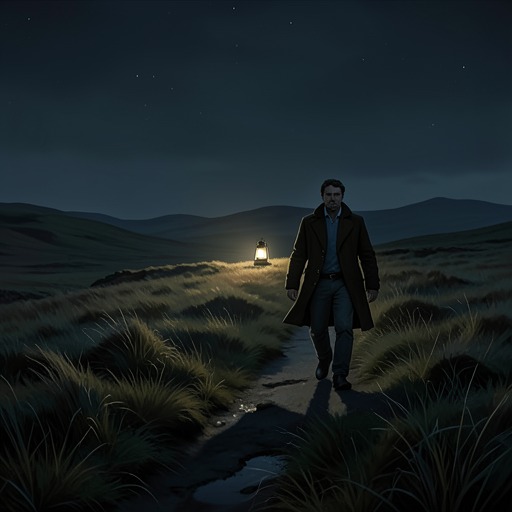
The moor’s scattered rocks and old structures provide places to hide, but they also make searches uncertain. On one evening pursuit, a single candle burns among the rocks, shielded from the wind and positioned so that it can be seen from Baskerville Hall but not from other directions. A granite boulder conceals the observers as they watch it. In this scene, the open moor becomes a space of surveillance: a small, carefully placed light can carry a message across the darkness while its source remains hidden.
Elsewhere, a searcher reaches a cleft in the hills containing a circle of old stone huts. One hut retains enough of its roof to shelter someone from the weather, and a faint path leads through the boulders to its broken entrance. The site appears to have been inhabited and is taken for the likely hiding place of a fugitive, but it is empty when searched. The episode shows how the moor can offer concealment without guaranteeing that a pursuer will find the person sought.
Visibility and Narrative Significance
Visibility on Dartmoor is unstable. At night, a distant light seems to shift between the horizon and a point only a few yards away, distorting the pursuers’ sense of distance. Later, dense white fog hangs over Grimpen Mire and drifts toward the observers, forming a low, clearly defined barrier beneath the moonlit tors. The fog makes the landscape itself seem to advance, while the mire and the surrounding heights turn weather into a limit on movement and sight.
These recurring conditions give the moor its narrative force. Its scale isolates Baskerville Hall from the few settlements around it; its landmarks demand local knowledge; and its hollows, stone huts, rocks, and fog conceal both people and danger. The same landscape that heightens the legend’s terror also supplies practical means for hiding, signaling, and pursuit, keeping uncertainty rooted in the physical ground.